
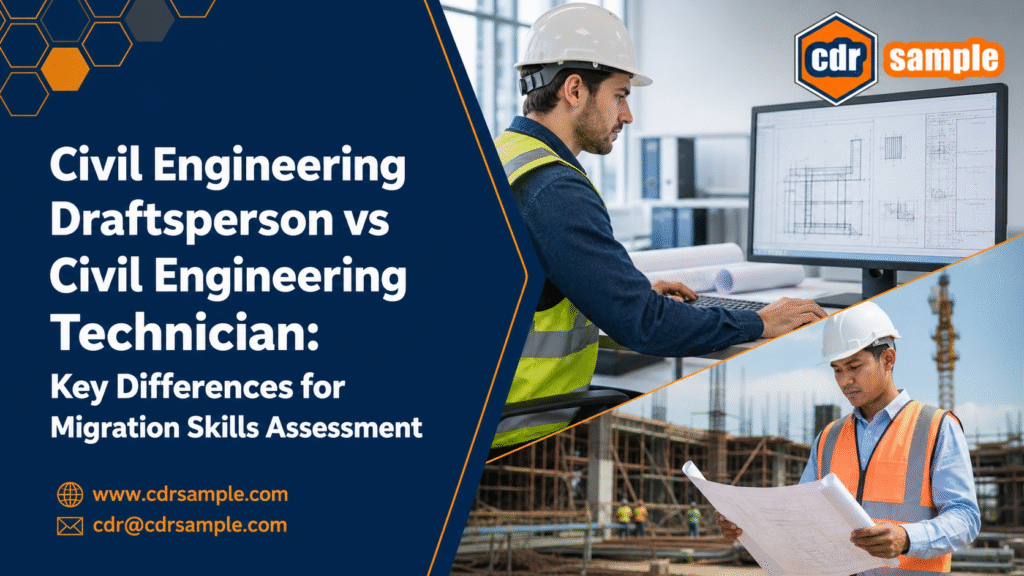
When planning your skilled migration pathway to Australia, selecting the correct ANZSCO occupation code is the most critical decision you will make. For professionals working in civil engineering support roles, the choice often comes down to Civil Engineering Draftsperson vs Civil Engineering Technician. While both of these occupations fall under the broader category of “Engineering Associate” according to Engineers Australia, they involve distinct daily responsibilities, work environments, and core competencies.
Understanding the differences between a Civil Engineering Draftsperson vs Civil Engineering Technician is essential for a successful Migration Skills Assessment (MSA). If your Competency Demonstration Report (CDR) does not perfectly align with the specific duties of your chosen occupation, your assessment may be delayed or rejected. This comprehensive guide will break down the roles, explore the Engineers Australia Stage 1 Competencies, and help you determine which career pathway is right for you.
What is a Civil Engineering Draftsperson (ANZSCO 312211)?
A Civil Engineering Draftsperson is primarily responsible for the design, documentation, and drafting phases of infrastructure projects. Working closely with Civil Engineers and Engineering Technologists, they translate complex engineering concepts into precise, actionable technical drawings, topographical plans, and 3D models.
Professionals in this role spend the majority of their time in an office environment, utilizing advanced Computer-Aided Design (CAD) software such as AutoCAD, Revit, MicroStation, and Civil 3D. Their work is the visual blueprint that construction teams rely on to build roads, bridges, railways, and water supply systems.
Key duties typically include:
-
Developing highly detailed technical drawings and structural plans from engineering sketches.
-
Calculating material quantities, estimating costs, and assisting with project budgets.
-
Ensuring all digital models and site plans comply with strict Australian building codes and safety regulations.
-
Continuously updating and revising drawings based on surveyor feedback and design changes.
If your career is focused on computer-aided design, spatial planning, and digital modelling rather than physical site work, the Draftsperson occupation is the ideal fit for your skills assessment.
What is a Civil Engineering Technician (ANZSCO 312212)?
In the debate of Civil Engineering Draftsperson vs Civil Engineering Technician, the Technician is the professional who ensures the physical viability of the drafted designs. A Civil Engineering Technician operates at the intersection of the laboratory, the office, and the active construction site. Their primary focus is on material testing, quality control, site inspection, and practical execution.
Instead of spending all day behind a CAD monitor, Technicians actively test soils, concrete, asphalt, and other raw construction materials to guarantee they can safely support the intended structures. They bridge the gap between theoretical engineering design and real-world construction realities.
Key duties typically include:
-
Conducting rigorous field and laboratory tests on various construction materials and soils.
-
Tabulating testing data, preparing analytical charts, and reporting findings to senior engineers.
-
Inspecting ongoing civil engineering works to ensure strict compliance with structural specifications and contract provisions.
-
Supervising routine maintenance and repair operations on existing civil infrastructure.
If your professional background involves hands-on material testing, site inspections, and practical problem-solving in the field, you should nominate the Technician role for your migration assessment.
Civil Engineering Draftsperson vs Civil Engineering Technician: Core Differences
When assessing the Civil Engineering Draftsperson vs Civil Engineering Technician pathway, the differences become clear when looking at the primary objective of each role. The Draftsperson creates the visual instructions, while the Technician verifies the physical materials and site conditions required to execute those instructions.
In your CDR, Engineers Australia assessors will look for these distinct characteristics. If you nominate Draftsperson but your Career Episodes heavily feature soil testing and site inspections, your application will likely face heavy scrutiny. Conversely, if you apply as a Technician but exclusively discuss your AutoCAD drafting skills, the assessor will struggle to find evidence of the required practical field competencies. Choosing the right occupation code ensures your Career Episodes naturally highlight the correct skill set.
Engineers Australia Stage 1 Competency Standards
Both the Draftsperson and Technician fall under the Engineering Associate category. To pass the migration skills assessment, applicants must demonstrate that they meet the Engineers Australia Stage 1 Competencies for this occupational category. According to Engineers Australia guidelines:
“Engineering Associates should have a generalized knowledge base that allows them to place their knowledge in the broadest possible context and accept professional responsibility for their work as fully qualified members of the engineering team”.
The Stage 1 competencies are broken down into three main elements: Knowledge and Skill Base, Engineering Application Ability, and Professional and Personal Attributes. Regardless of whether you are applying as a Draftsperson or Technician, your CDR must prove that you possess these competencies at an Australian standard.
Engineers Australia states that for Engineering Associates, the required educational foundation is quite specific:
“Stage 1 competency is equivalent to completing a two-year Advanced Diploma of Engineering or Associate Degree of Engineering (AQF Level 6) that includes a program of Engineers Australia-approved units of competency or courses”.
If your qualifications are from overseas and are not accredited under the Sydney or Dublin Accords, you must use the CDR pathway to prove your equivalence to this standard. Engineers Australia makes the ultimate expectation clear:
“The Competencies and Elements of Competency, when taken together, constitute the profession’s expression of knowledge and skills, engineering application abilities, and professional skills, values, and attitudes that must be demonstrated at the point of entry to practice“.
Navigating the CDR Requirements
When preparing your Competency Demonstration Report for either a Civil Engineering Draftsperson vs Civil Engineering Technician, you must submit three Career Episodes, a Continuing Professional Development (CPD) statement, and a Summary Statement.
Your Career Episodes must be written in the first person (using “I” rather than “we”) and focus entirely on your specific, individual contributions to a project.
-
For a Draftsperson: Your episodes should detail complex design challenges you solved using CAD software, how you ensured regulatory compliance in your drawings, and how you collaborated with engineers to refine spatial plans.
-
For a Technician: Your episodes should focus on specific material tests you conducted, how you analyzed the physical data, and the steps you took to enforce quality control on the construction site.
The Summary Statement is where you will cross-reference the paragraphs in your Career Episodes with the specific Engineers Australia Stage 1 Competencies. This is the most technically demanding part of the application, as it requires a deep understanding of how your daily tasks map to Australia’s engineering standards.
Need Help Preparing Your CDR?
Deciding between a Civil Engineering Draftsperson vs Civil Engineering Technician is just the first step in your migration journey. Proving your competency through a flawless CDR is the hurdle that stops many talented professionals from securing their Australian visa. A single mistake in your Career Episodes or a poorly mapped Summary Statement can cost you months of time and thousands of dollars in application fees.
You do not have to navigate this complex process alone. At cdrsample.com, our team of engineering specialists understands the exact nuances that separate a Civil Engineering Draftsperson vs Civil Engineering Technician. We provide industry-leading CDR writing, comprehensive reviewing, and strict plagiarism-checking services tailored to Engineers Australia’s exacting standards.
Don’t leave your migration assessment to chance. Visit CDRsample today to get expert assistance and ensure your CDR application is approved the first time!